Consolidated Finance Multiple Shopify Stores
How multi-store Shopify merchants can unify revenue, payouts, and expenses into one dashboard to scale profitably without manual overhead.
Key points — AI summary
- Payout timing fragments across stores — Shopify Payments settles in 2 to 7 business days depending on region, and each store can run its own daily/weekly/monthly schedule
- Dashboard sales figures don't match bank deposits because Shopify deducts fees, refunds, and chargebacks before payout — with five stores, five different lag times, and five fee structures, manual reconciliation becomes a full-time job
- Real consolidation needs three things: live API integration instead of manual export-and-merge, standardized/normalized reporting across stores, and automated reconciliation instead of manual matching
- Without consolidation, every new store adds proportional overhead; with it, the operational cost of running a 5th store is nearly identical to a 50th
- Pricing per company instead of per store means consolidating finance across 5 stores or 150 costs the same
Summarized from this article by our writing pipeline; reviewed by the author.
On this page
If you manage more than one Shopify store, you've already felt the pain: switching between dashboards to check payouts, reconciling deposits that don't match your sales figures, and manually compiling revenue reports from separate accounts. Every additional store multiplies this overhead. Consolidated finance across all your Shopify stores isn't a luxury—it's essential for profitable operations at scale.
Why Multi-Store Finance Becomes Complex So Quickly
Operating multiple Shopify stores creates financial visibility problems that grow exponentially, not linearly. Here's what breaks down:
Payout Fragmentation
Each Shopify store has its own payout schedule and bank account configuration. Shopify Payments offers settlement times ranging from 2 to 7 business days depending on your region, and merchants can choose daily, weekly, or monthly frequency. But this flexibility creates a coordination nightmare when you're managing multiple stores—you're now tracking dozens of separate payout cycles, each with different fees and reserve policies.
Revenue Reconciliation Breaks Down
Sales shown on your Shopify dashboard don't match bank deposits. Why? Shopify deducts transaction fees, refunds, and chargebacks before the payout arrives. When you have five stores, five different time lags, and five different fee structures, manual reconciliation becomes a full-time job.
Cost Allocation Is Manual
If you share warehousing, customer service, or ad spend across stores, allocating those costs fairly requires manual spreadsheet work. Without systematic allocation, you lose visibility into which store is actually profitable — a problem that bites hardest for dropshippers consolidating supplier costs, ad spend, and processor fees. Marketing spend blurs across brands, making it impossible to optimize budget per store.
Tax Compliance Multiplies
Every store in a different tax jurisdiction adds complexity. You need to track sales tax nexus, income tax allocation, and separate entity reporting obligations, and Shopify's native tools don't handle cross-store consolidation or tax strategy.
Inventory & Payable Tracking Falls Apart
Inventory transfers between stores require proper accounting treatment. Vendor payments, refund processing, and chargebacks across multiple stores get lost in separate admin panels.
What Real Financial Consolidation Requires
True consolidation isn't just viewing all stores in one place—it's automating the connection between Shopify, your bank, your accounting software, and your cash flow tracking. Best practices show three critical steps:
1. Real-time API Integration Standalone dashboard views are snapshots; you need live API connectivity so that every order, refund, fee, and payout syncs instantly. This eliminates the manual export-and-merge cycle that introduces delays and errors.
2. Standardized Reporting Structure Each store may have different product catalogs, fulfillment workflows, or currency settings. Consolidation requires data normalization—creating consistent reporting across stores with potentially different structures. You need to see revenue, ad spend, and payouts in a single, comparable format.
3. Automation of Reconciliation Instead of manually matching Shopify payout reports to bank deposits, automated reconciliation maps income streams, organizes fees, and reconciles bank deposits so your finance team can view all numbers in one place.
The Business Case for Unified Finance
Consolidated finance delivers three concrete benefits:
Faster Decision-Making: You see actual profitability by store in minutes, not days. If one store is underperforming, you spot it immediately.
Audit-Ready Records: Separate payout timelines and fee structures no longer scatter your transactions across spreadsheets. Everything is traceable and reconciled.
Headroom to Scale: Without consolidation, each new store adds proportional overhead. With it, the operational cost of managing your 5th store is nearly identical to your 50th. You can scale without hiring.
What a Consolidated Finance Layer Actually Does
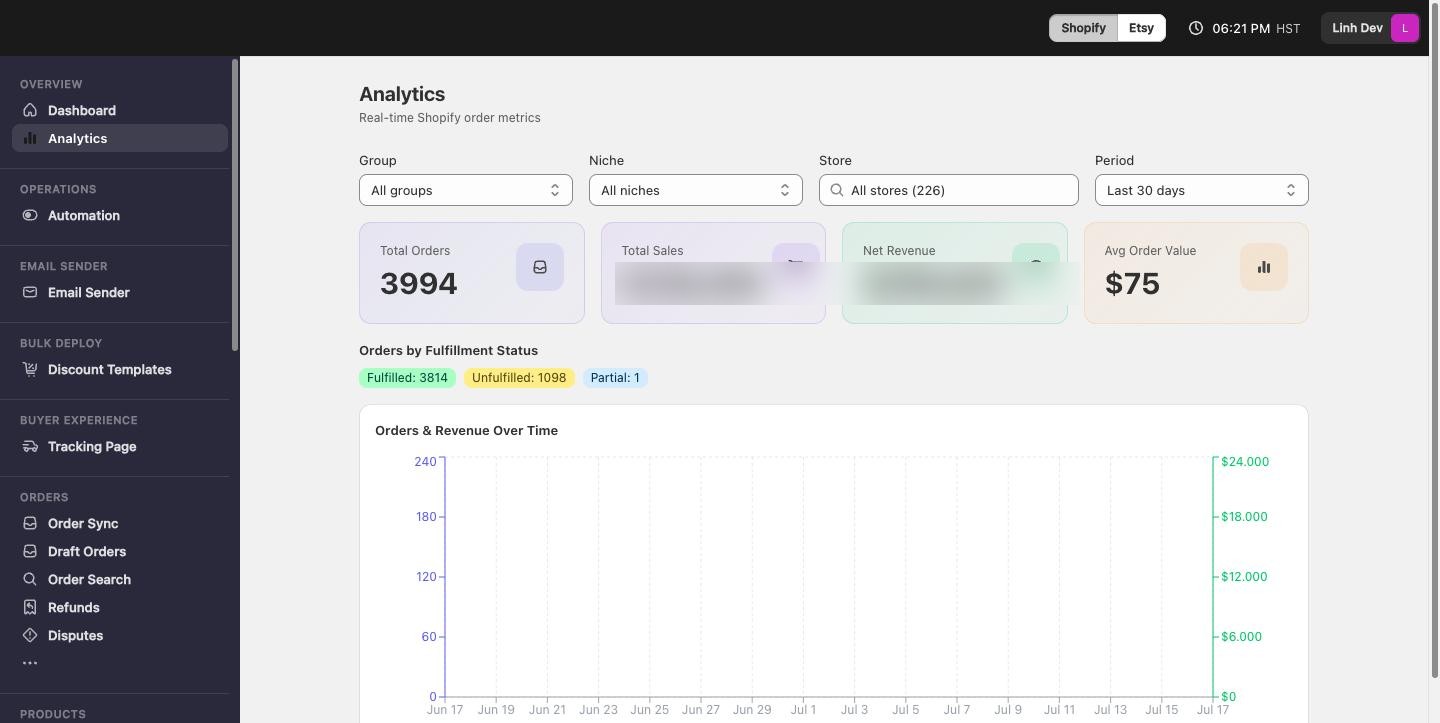
Rather than juggling 10, 20, or 30+ browser tabs, a consolidated finance view pulls every store into a single real-time dashboard—revenue, ad spend, and payouts all in one place. Orders, shipments, disputes, and chargebacks are tracked by store and sorted by priority.
The platform also handles the workflows that actually cause finance friction: automatic order sync to Google Sheets, bulk shipment tracking with stuck-shipment alerts, and chargeback tracking organized by evidence deadline. Permission controls let your finance team access consolidated reports while keeping store ops and marketing staff focused on their own domains.
Pricing is per-company, not per-store, so managing 5 stores or 150 costs the same.
Getting Started
Consolidation doesn't require ripping out your current setup. The best approach is to test it against your specific workflow on real data first — run one month's orders, payouts, and shipments through a single consolidated view and see whether reconciliation time actually drops before you commit to anything.
FAQ
Why don't my Shopify payouts match my dashboard sales figures?
Shopify deducts transaction fees, refunds, and chargebacks before the payout arrives, so deposits lag behind and differ from dashboard sales — and with several stores you're juggling several fee structures and time lags at once.
How long do Shopify payouts take?
Shopify Payments settles in 2 to 7 business days depending on your region, and each store can run its own daily, weekly, or monthly schedule.
What does real financial consolidation actually require?
Three things: live API integration instead of manual export-and-merge, standardized reporting across stores, and automated reconciliation instead of manually matching payout reports to bank deposits.
Does managing more stores mean proportionally more finance overhead?
Not with consolidation — the operational cost of running your 5th store becomes nearly identical to your 50th, and per-company pricing means 5 or 150 stores cost the same.